Whole-House Filtration vs Point-of-Use Filters
Whole-house filtration treats every tap; point-of-use filters treat one. Here's how each performs on Queen Creek's 12-17 grain hard water, and what each costs in 2026.
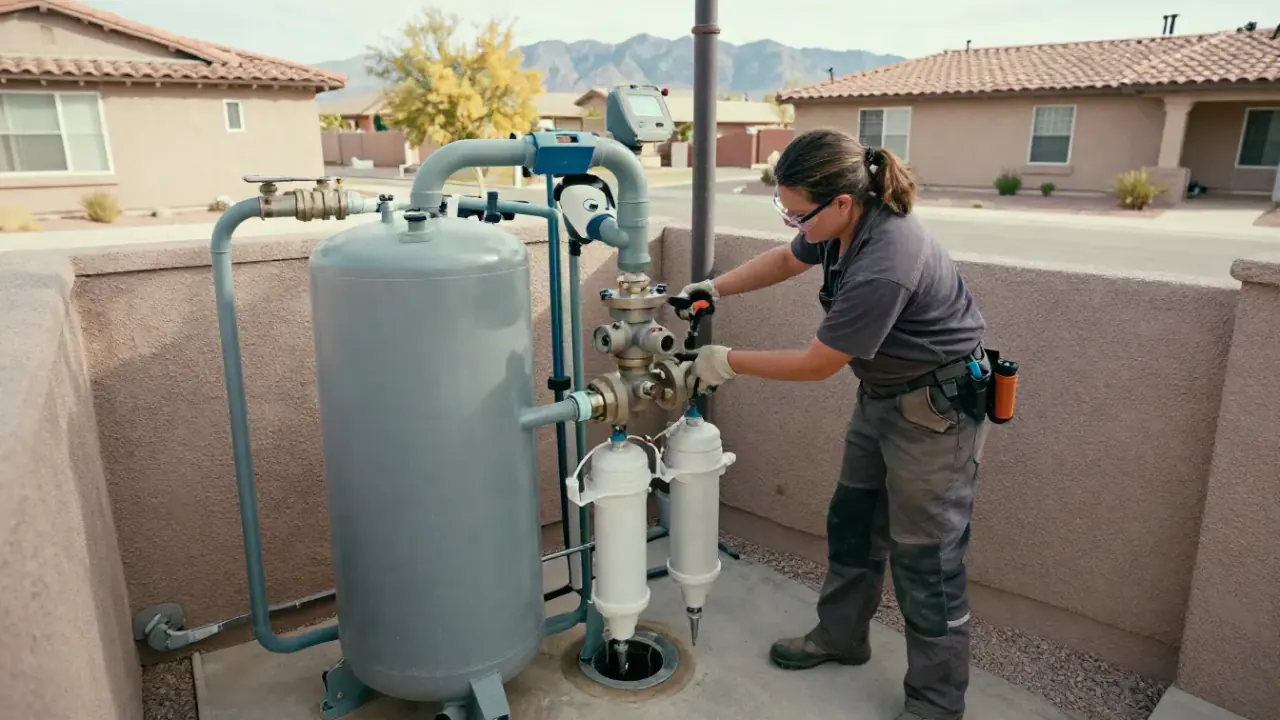
Whole-house filtration treats every tap in the house at the point where water enters, while point-of-use filters treat a single fixture, usually the kitchen sink. If your goal is protecting pipes, the water heater, and every showerhead from Queen Creek's 12 to 17 grain hard water, whole-house wins. If your only goal is better-tasting drinking water at the lowest upfront cost, a point-of-use unit gets you there for a fraction of the money.
Whole-house filtration vs point-of-use filters is not really an either/or question once you understand what each one is built to do. Below we break down the difference, real 2026 pricing in Queen Creek, the pros and cons of each, and the layered setup we install in most homes here.
The Short Answer: Whole-House vs Point-of-Use
Whole-house filtration is a treatment system installed on your main water line that filters or conditions every gallon entering the home, while point-of-use filtration is a small unit mounted under a single sink or on a single faucet. The two solve different problems, and the right answer depends on whether you care more about your plumbing or your glass of water.
Here is the one-line version:
- Whole-house - protects pipes, fixtures, water heater, and appliances. Higher upfront cost, low maintenance per gallon.
- Point-of-use - protects your drinking water only. Low upfront cost, higher cost per gallon treated.
If you have hard water and you have not tested it, that is the first step. Our water hardness test Queen Creek service tells you exactly what you are dealing with before you spend a dollar on equipment.
What Is the Difference Between Whole-House and Point-of-Use Filters in Queen Creek AZ?
The difference between whole-house and point-of-use filters in Queen Creek AZ comes down to location and scope: one sits on the main line and serves the entire home, the other sits at a single tap and serves only that tap. Everything else - cartridge type, flow rate, cost, maintenance - flows from that single distinction.
Whole-house systems
These mount where your water service enters the house, usually in the garage or a utility closet. A whole-house carbon filter or a softener treats every gallon that goes to showers, laundry, the dishwasher, and the water heater. Flow rates run 7 to 15 gallons per minute on residential units, which is enough to run a shower and the washing machine at the same time without a pressure drop.
Point-of-use systems
These are the under-sink reverse osmosis units and faucet-mount carbon filters you see at big-box stores. They treat 0.5 to 1.5 gallons per minute and only at the fixture they are attached to. The rest of the house - the shower, the laundry, the water heater - sees completely untreated water.
That last point matters more in Queen Creek than almost anywhere in the Valley. Our municipal supply comes largely from CAP water and groundwater wells, and the mineral content is high enough that we routinely measure 12 to 17 grains per gallon. Anything above 7 grains is considered hard. We are well past that.
How Each System Performs on Queen Creek's Hard Water
Queen Creek's hard water is the single biggest factor in this decision, because hardness is what destroys plumbing, not taste. A point-of-use filter does nothing about hardness - it improves the water you drink and leaves the scale-forming minerals in every other line of the house.
Here is what that looks like in practice. At 14 grains per gallon, a typical Queen Creek household of four pushes roughly 250,000 grains of hardness through the plumbing every month. That calcium and magnesium precipitates out as scale anywhere water sits or heats:
- Water heater tanks lose efficiency as scale builds on the element or burner - roughly 1% efficiency loss per 1/16 inch of scale, and we see tanks with a quarter inch or more after three or four years.
- Showerheads and aerators clog in 12 to 24 months.
- Dishwashers leave spotting and etch glass.
- Toilets, ice makers, and washing machine valves wear out early.
A whole-house softener or conditioner removes that hardness before it reaches any of those fixtures. A point-of-use RO unit under the kitchen sink removes it from one faucet. If scale is your problem, only one of those two answers actually solves it.
We install and service these systems across the East Valley, including in neighborhoods like Encanterra water softener installs where the homes are newer but the water is just as hard as anywhere else in town.
Whole House vs Under Sink Water Filter: Cost in Queen Creek
Whole house vs under sink water filter cost in Queen Creek is where most homeowners make the decision, so let's put real numbers on it. Typical 2026 pricing in this area looks like this:
Point-of-use (under-sink RO or carbon)
- Equipment: $200 to $600 for a quality under-sink RO; $40 to $150 for a faucet-mount carbon filter.
- Installation: $150 to $400 if you want it done right with a proper drain saddle and shutoff.
- Filters: $60 to $120 per year, replaced every 6 to 12 months.
- Total first year: roughly $400 to $1,100.
Whole-house filtration and softening
- Equipment: $1,200 to $3,500 depending on capacity and whether you are softening, filtering, or both.
- Installation: $400 to $900 for a standard main-line tie-in with a bypass valve and drain line.
- Salt and maintenance: $80 to $200 per year for a softener; carbon media replacement every 3 to 5 years.
- Total first year: roughly $1,700 to $4,600.
The upfront gap is real - three to four times the cost. But the per-gallon math flips. A whole-house system treats every gallon in the house for pennies; an under-sink RO treats maybe 3 to 5 gallons a day and costs more per gallon than bottled water if you only count drinking water.
If you want the full breakdown of what a whole-home setup looks like, our whole house water filter Queen Creek page covers equipment options and what fits different home sizes.
Whole House Filtration Pros and Cons
Whole-house filtration pros and cons come down to scope versus cost: you protect everything, and you pay for it upfront. Here is the honest list.
Pros
- Protects the water heater, dishwasher, washing machine, and every fixture from scale.
- Softer water means less soap, less detergent, and noticeably better showers.
- One system, one maintenance schedule, no cartridges under every sink.
- Adds resale value - buyers in Queen Creek ask about water treatment.
Cons
- Higher upfront cost, typically $1,700 to $4,600 installed in 2026.
- Requires space near the main line and a drain for softener regeneration.
- Softened water has a slight sodium content - usually fine, but worth knowing if you are on a sodium-restricted diet.
- Does not by itself give you RO-quality drinking water; you still want a point-of-use unit at the kitchen sink for that.
One more con worth naming: a whole-house system is only as good as its install. A softener tied into the wrong line, or one sized for a two-person home in a six-person house, will underperform and you will blame the equipment. We size every system to the household, not to the box.
Point-of-Use Pros and Cons
Point-of-use filters are the right answer when drinking water quality is the only thing you care about and budget is tight. They are not a substitute for whole-house treatment on hard water.
Pros
- Lowest upfront cost - under $500 installed for a good under-sink RO.
- Excellent drinking water quality; RO removes 90%+ of dissolved solids.
- No main-line plumbing work, no drain line, no salt.
- Easy to replace or upgrade later.
Cons
- Does nothing for hardness, scale, or the water heater.
- Higher cost per gallon treated.
- Filter changes are easy to forget - we see RO membranes two years past due all the time.
- Only one tap benefits; the rest of the house still runs hard.
If you want RO at the kitchen sink, we install them regularly - see our reverse osmosis system Queen Creek page for the options we carry and how we tie them into a whole-house setup.
Can You Run Both? The Layered Setup We Recommend
You can absolutely run both, and for most Queen Creek homes that is the setup we recommend: a whole-house softener or conditioner on the main line, plus a point-of-use RO at the kitchen sink. The whole-house system handles hardness and protects the plumbing; the RO polishes the drinking water to bottled-quality.
This is the same layered approach we use on installs across the area, from Water Softener in Ironwood Crossing to older homes near Queen Creek Station water softener retrofits where we are tying into existing copper and PEX. The order matters: soften first, then filter, then RO at the tap.
If you are not sure whether you need softening at all, start with a hardness test. If you measure under 7 grains, a whole-house carbon filter alone may be enough. Above 10 grains - which is most of Queen Creek - you want a softener in the mix.
Common Mistakes We See on Queen Creek Installs
Most of the problems we get called out to fix are install mistakes, not equipment failures. Here are the ones we see most often.
- Sizing to the house, not the household. A 32,000-grain softener is fine for two people and useless for six. Match grain capacity to daily water use, not square footage.
- Softening the outdoor hose bibs. You are paying to soften irrigation water. Bypass the exterior lines.
- Skipping the bypass valve. Without one, you cannot service the unit without shutting off the whole house.
- Running softened water to the kitchen cold tap and then adding RO on top. That is fine, but running raw hard water to the RO membrane shortens its life by years.
- Ignoring the drain line. Softener regeneration discharge has to go somewhere legal. We see it dumped into flower beds more often than you would think.
- Never testing after install. A system that is plumbed right but programmed wrong will still leave you with hard water. We test at the tap before we leave.
If your existing softener is limping along, sometimes the fix is a softener valve repair Queen Creek job rather than a full replacement - the valve and control head are what fail first, not the tank.
When to Call a Professional
Call a professional when you cannot verify your water hardness, when your existing softener is not keeping up, or when you are ready to tie anything into the main line. Main-line plumbing is not a DIY job - one bad solder joint or a cross-threaded fitting and you are looking at water damage.
We are a local, state-licensed water treatment contractor serving Queen Creek and the surrounding East Valley. We test your water, size the system to your household, install it with a proper bypass and drain, and verify the result at the tap before we leave. If you already have equipment, we will tell you honestly whether it needs repair or replacement.
If you want a starting point, our Water Softener Queen Creek AZ page covers what we do and how we work.
Frequently Asked Questions
What is the difference between whole-house and point-of-use filters in Queen Creek AZ?
Whole-house filters treat every gallon entering the home from the main water line, protecting plumbing, fixtures, and appliances. Point-of-use filters treat a single tap, usually the kitchen sink. In Queen Creek's 12-17 grain hard water, only whole-house treatment addresses scale; point-of-use addresses drinking water quality only.
Which is better, whole house or under sink filter in Queen Creek Arizona?
For hard water, whole-house is better because it protects the water heater and every fixture from scale. For drinking water quality on a tight budget, under-sink RO is better. Most Queen Creek homes do best with both: a whole-house softener plus an under-sink RO at the kitchen tap.
Do I need whole house filtration in Queen Creek?
If your water tests above 10 grains per gallon - which is typical here - yes, you need whole-house softening to protect your plumbing and appliances. A whole-house carbon filter alone helps with taste and chlorine but does not remove hardness. Test first; the number tells you what you need.
Can I use both whole house and point of use filters in Queen Creek?
Yes, and we recommend it. Run the whole-house softener or conditioner on the main line, then add an under-sink RO at the kitchen sink for drinking water. Soften first, then filter, then RO at the tap. This layered setup gives you protected plumbing and bottled-quality drinking water.
How much does whole house filtration cost in Queen Creek AZ?
Typical 2026 pricing runs $1,700 to $4,600 installed for a whole-house softener or filtration system, including equipment, main-line tie-in, and first-year salt or media. Point-of-use RO units run $400 to $1,100 installed in the first year. The whole-house system costs more upfront but far less per gallon treated.
Get Help with Water Softener in Queen Creek
Whether you go whole-house, point-of-use, or both, the first step is knowing what is actually in your water. We test it, size the system to your household, and install it so it works the first time.
Call Queen Creek Water Softener at (480) 337-3003 to schedule a hardness test or get a straight answer on what your home needs.