Spotting Dishes and Glass: Causes and Fixes
Spots on dishes and cloudy glasses are hard water telling you exactly what's in your Queen Creek tap water. Here's why it happens and how to fix it.
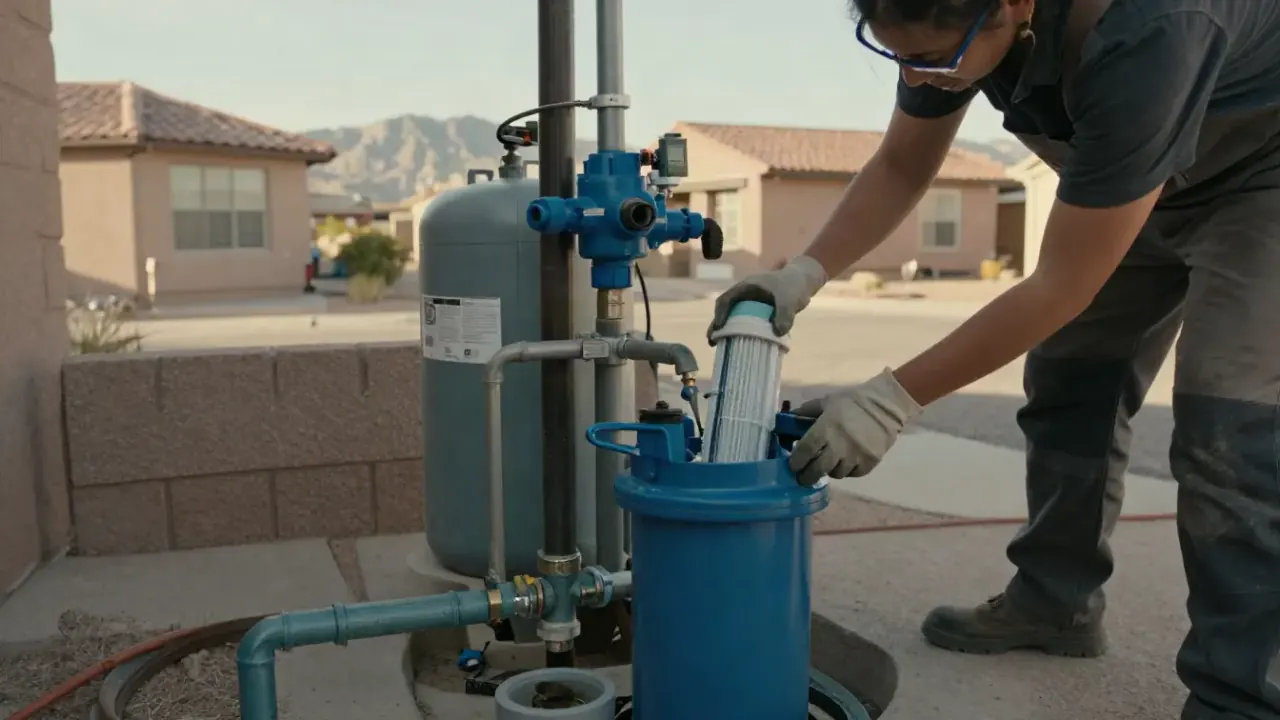
Spotting dishes and glass causes and fixes come down to one thing: the minerals in your water. If your glasses come out of the dishwasher with white film or chalky streaks, you have hard water - and in Queen Creek, that's almost a guarantee. The fix is either a rinse-aid band-aid or treating the water at the source. This post walks through what's actually happening, why it's worse here than in most of the country, and the exact steps we take to stop it.
We install and service water softeners across Queen Creek, San Tan Valley, and Gilbert, and spotting complaints are one of the top three reasons people call us. Here's what we tell them.
Why Do My Dishes Have Spots in Queen Creek AZ?
Your dishes have spots because dissolved calcium and magnesium stay behind as a white residue when water droplets evaporate. Queen Creek's municipal supply pulls from groundwater and CAP allocations that run hard - we routinely measure 12 to 18 grains per gallon (gpg) on residential taps here, and some wells on the east side of town push past 20 gpg. Anything above 7 gpg is classified as hard. Above 10.5 gpg is very hard.
When your dishwasher runs its final rinse, that mineral-heavy water clings to every surface. The heating element dries it. The water leaves. The calcium and magnesium don't. What's left is the chalky film you're scraping off your wine glasses with a fingernail.
Three things make it worse in our area:
- High baseline hardness. Queen Creek water is among the hardest in Maricopa County.
- Warm incoming water. Even in October, our cold line sits around 78-82°F, and hot water heaters hold 120-140°F. Warm water holds more dissolved minerals, so more of them drop out on your dishes.
- New construction plumbing. Homes built in the last 10 years across Water Softener in Ironwood Crossing and similar communities often have undersized softener loops - or none at all.
If you want to know your exact number, we run a Water Hardness Testing Queen Creek AZ on-site in about 15 minutes. No guessing.
What Causes Cloudy Glasses in Queen Creek
Cloudy glasses in Queen Creek are caused by two different problems that look similar but need different fixes: surface film and etched glass.
Surface film (reversible)
This is the mineral deposit we just described. It sits on top of the glass. A 10-minute soak in white vinegar or a citric acid solution strips it off. If your glass clears up after an acid soak, you have film - not damage.
Etching (permanent)
Etching is when the minerals, combined with the high heat of the dishwasher's drying cycle and the alkalinity of most dishwasher detergents, chemically bond with the silica in the glass itself. The glass is permanently scarred. No amount of vinegar brings it back. Etching usually takes 2-4 years of daily dishwasher cycles to develop in Queen Creek's water.
You can tell the difference with one test: soak a cloudy glass in vinegar for 15 minutes. If it clears, it's film. If it's still cloudy, it's etched, and the only fix is replacing the glassware - and treating the water so the next set doesn't go the same way.
How to Fix Spots on Dishes: What Actually Works
How to fix spots on dishes depends on whether you want a temporary patch or a permanent solution. Here's the honest ranking, from cheapest to most effective.
- Rinse aid. $6-$10 per bottle. Helps water sheet off instead of beading. Reduces spotting maybe 40-60%. Doesn't remove the minerals - it just moves them around.
- Citric acid or vinegar in the rinse cycle. Cheap and effective short-term. About 1/4 cup of white vinegar in the bottom of the dishwasher before the rinse. Works, but you'll do it every load.
- High-quality dishwasher detergent with built-in softeners. Better than the bargain brands. Still not a fix.
- Adjusting your dishwasher's heat-dry setting. Turning off heated dry and cracking the door after the cycle reduces spotting noticeably. Costs nothing.
- A whole-house water softener. Removes the calcium and magnesium before they ever reach the dishwasher. This is the only fix that solves it at the source.
If you're also fighting white scale on faucets, showerheads, and the inside of your water heater, the dishwasher is just the most visible symptom. A Water Softener Queen Creek AZ handles all of it at once.
Does a Water Softener Fix Dish Spotting in Queen Creek?
Yes - a properly sized and functioning water softener eliminates 95%+ of hard water spotting on dishes and glassware in Queen Creek. That's not marketing. It's chemistry. A softener swaps the calcium and magnesium ions for sodium ions through an ion-exchange resin bed. Sodium doesn't leave a chalky residue when water evaporates. No minerals, no spots.
Two caveats we always tell customers:
- The softener has to be sized right. A 24,000-grain unit on a family of five with 16-gpg water will exhaust itself mid-week and let hard water through. We size based on hardness, household size, and daily gallons - usually 32,000 to 48,000 grain for a Queen Creek home.
- The softener has to actually be working. A softener that's out of salt, has a stuck control valve, or has a fouled resin bed is worse than no softener at all - you think you're protected and you're not. We see this constantly in Water Softener in Queen Creek Station and other neighborhoods where the original builder-grade unit is now 8-12 years old.
If your softener is 10+ years old, a Resin Tank Replacement Queen Creek AZ is often cheaper than a full new system and restores performance to day-one levels.
Common Mistakes We See in Queen Creek Kitchens
Most spotting complaints we get called out on trace back to one of these five mistakes. Fix them and you'll see immediate improvement.
- Running the dishwasher without soft water and blaming the dishwasher. The appliance is fine. The water isn't.
- Using too much detergent. More soap does not mean cleaner dishes. In hard water, excess detergent leaves its own film. Use the recommended amount and let the softener do the work.
- Loading glasses so they nest. Water can't drain, so it pools and dries in place. Leave space between every glass.
- Ignoring the softener for months. Check the salt level every 4-6 weeks. In Queen Creek's heat, a softener can burn through a 40-lb bag of salt in 3-4 weeks for a family of four.
- Letting a softener sit unused through a vacation. Resin beds can develop channeling or bacterial issues if they sit idle for weeks. Run a manual regeneration when you get home.
One more: don't skip the Brine Tank Cleaning Queen Creek AZ every 12-18 months. Salt bridges and mushy brine tanks are the number one reason a softener silently stops working.
When to Call a Professional
Call us when the spotting has been going on for more than a few weeks, when you've tried rinse aid and vinegar and nothing sticks, or when your existing softener is more than 8 years old and you're not sure it's doing anything. Those are all signs the problem is in the water, not the dishwasher.
We also get called when a softener is running but the dishes are still spotted - that's almost always a control valve issue, a resin failure, or a salt bridge. We diagnose it in one visit, tell you what it costs before we start, and fix it the same day when parts allow.
If you're in a newer community like Water Softener in Hastings Farms and your home was built without a softener loop, we can usually install a system in 2-3 hours with no drywall work. If you're on a well, we'll test first - well water often needs iron and manganese treatment before softening, and we handle that with a Whole-House Water Filtration Queen Creek AZ setup ahead of the softener.
Frequently Asked Questions
Why do my dishes have spots in Queen Creek AZ?
Because Queen Creek's water runs 12-18 grains per gallon of hardness - well above the 7 gpg threshold. When water dries on your dishes, dissolved calcium and magnesium stay behind as white spots. It's not your dishwasher; it's the water going into it.
How do I fix hard water spots on glasses in Queen Creek Arizona?
For a quick fix, soak glasses in white vinegar for 15 minutes or add 1/4 cup vinegar to the dishwasher rinse cycle. For a permanent fix, install a properly sized water softener. Vinegar removes existing spots; a softener prevents new ones from forming.
What causes cloudy glasses in Queen Creek?
Two things: removable mineral film and permanent etching. Film clears with a vinegar soak. Etching - caused by minerals bonding with the glass under dishwasher heat - does not. Etching typically develops after 2-4 years of washing in hard water without softening.
Does a water softener fix dish spotting in Queen Creek?
Yes. A correctly sized, working softener removes 95%+ of the calcium and magnesium before water reaches your dishwasher, which eliminates nearly all spotting. The key is proper sizing (usually 32,000-48,000 grains here) and keeping the unit maintained.
How to remove hard water spots from dishes in Queen Creek?
Soak in a 1:1 white vinegar and water solution for 15-30 minutes, then wash normally. For heavier buildup, use a citric acid powder dissolved in warm water. If spots return within a week, the water itself needs treatment, not more cleaning.
Get Help with Water Softener in Queen Creek
If your dishes and glasses are coming out spotted no matter what you try, the problem is in the water - and we fix that every day in Queen Creek. Call us at (480) 337-3003 and we'll test your water, size the right system, and have you running spot-free within a day.